







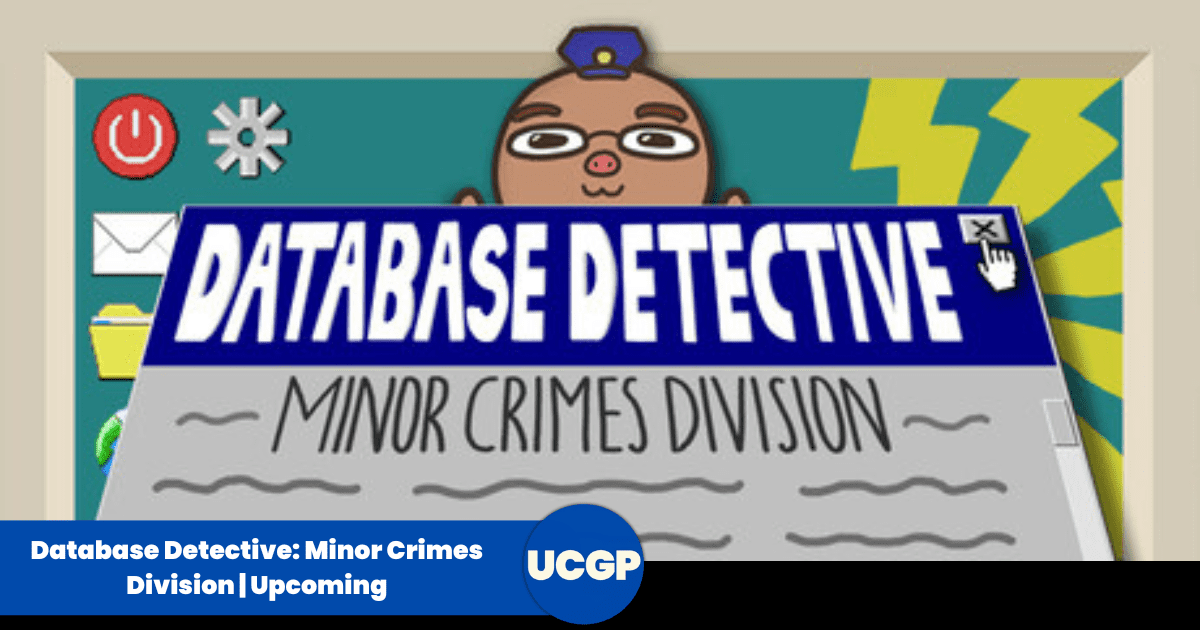

Database Detective: Minor Crimes Division – Release Date, Gameplay & News
Written by Qamar Shahzad, a gaming journalist with 15+ years of industry experience. Published June 2026.
Quick Facts
| Detail | Information |
|---|---|
| Developer | Little Red Dog Games |
| Publisher | Little Red Dog Games |
| Genre | Puzzle, Adventure, Detective, Mystery, Indie |
| Platform | PC (Windows) via Steam |
| Game Type | Puzzle Adventure / Detective Simulation |
| Engine | Not officially confirmed |
| Release Window | July 2026 (Steam listing) |
| Multiplayer | Single-player only |
| Official Website | Steam Store Page |
| Social Media | Not officially confirmed |
Introduction
Detective games have always held a special place in the gaming landscape. There’s something deeply satisfying about piecing together clues, connecting dots, and finally arriving at that “aha” moment when everything clicks into place. Over the years, we’ve seen this genre evolve in fascinating ways, from classic point-and-click adventures to more experimental narrative experiences.
Database Detective: Minor Crimes Division takes this evolution in a genuinely fresh direction. Instead of exploring crime scenes or interrogating suspects face to face, you’re sitting at a computer terminal, searching through police databases to solve cases. It’s a concept that sounds deceptively simple but has the potential to deliver some of the most engaging detective work in recent memory.
Developed by Little Red Dog Games, this upcoming indie title puts players in the role of a detective working in the Minor Crimes Division. Your job is to investigate seemingly ordinary crimes by searching, filtering, and cross-referencing police records. The cases you handle might start out small, but there’s a suggestion that larger conspiracies lie hidden beneath the surface of these routine reports.
For fans of mystery games like Her Story, The Case of the Golden Idol, and Return of the Obra Dinn, Database Detective offers a similar focus on logical deduction but with a unique twist. Instead of exploring environments or watching video clips, you’re working with structured data. You’re not chasing suspects through alleyways. You’re chasing leads through digital records.
In this article, we’ll cover everything we know so far about Database Detective: Minor Crimes Division. We’ll explore its release date, gameplay mechanics, platform availability, community response, and what this unusual detective game might offer puzzle enthusiasts. Whether you’re a seasoned mystery game veteran or simply curious about this unique concept, this guide has you covered.
Why This Game Matters
The detective genre has seen something of a renaissance over the past decade. Games like Her Story and Return of the Obra Dinn proved that players are hungry for intelligent, challenging mystery experiences that respect their intelligence. These games don’t hold your hand. They trust you to figure things out on your own.
Database Detective: Minor Crimes Division enters this space with a concept that feels both fresh and logical. In an era where data drives so much of our lives, a game built around database searching and information analysis feels remarkably contemporary. It’s a detective game for the digital age.
From an industry perspective, Little Red Dog Games is positioning this as a standalone IP with a clear identity. It’s not trying to compete with big-budget detective games like L.A. Noire or Sherlock Holmes. Instead, it’s carving out its own niche, offering a more cerebral, analytical approach to crime-solving that emphasizes thought over action.
For players, the appeal is obvious. There’s a growing audience for games that challenge the mind rather than reflexes. The success of titles like The Witness and Return of the Obra Dinn has shown that puzzle games with unique mechanics can find dedicated audiences. Database Detective’s database-focused gameplay taps into this demand while offering something genuinely different.
The game also touches on something deeper: the fascination with police work and criminal investigations. Shows like CSI and Law & Order have long captured public imagination, and games like this let players engage with that world in an interactive way. The focus on “minor crimes” is also interesting, suggesting a more grounded, realistic approach compared to the world-ending conspiracies of many detective stories.
Game Overview Table
| Aspect | Details |
|---|---|
| Full Game Name | Database Detective: Minor Crimes Division |
| Developer | Little Red Dog Games |
| Publisher | Little Red Dog Games |
| Genre | Puzzle, Adventure, Detective, Mystery, Indie |
| Game Engine | Not officially confirmed |
| Platforms | PC (Windows) via Steam |
| Game Type | Puzzle Adventure / Detective Simulation |
| Franchise Background | Standalone IP; no predecessor |
| Official Website | Steam Store Page |
| Social Media | Not officially confirmed |
What We Know So Far
Confirmed Information
Based on the official Steam store page and available promotional materials, the following details are confirmed:
- PC release via Steam (Windows)
- Single-player experience
- Database-driven gameplay focused on searching and filtering records
- Multiple investigations and cases to solve
- Logic-based puzzles requiring deduction and analysis
- Non-linear investigations with multiple paths
- Stylized interface designed to resemble police database software
- July 2026 release window (Steam listing)
Rumours & Unconfirmed Details
The following items are speculative and should not be treated as confirmed:
- Console versions (PlayStation, Xbox, Nintendo Switch)
- User-created cases or Steam Workshop support
- Procedurally generated investigations
- DLC expansions with additional cases
- Multiple endings based on investigation outcomes
Confirmed vs. Rumored Comparison Table
| Feature | Status |
|---|---|
| PC / Steam release | ✅ Confirmed |
| Single-player | ✅ Confirmed |
| Database investigation mechanics | ✅ Confirmed |
| Multiple cases | ✅ Confirmed |
| Logic-based puzzles | ✅ Confirmed |
| Non-linear investigations | ✅ Confirmed |
| Console versions | ❓ Rumoured |
| User-created cases | ❓ Rumoured |
| Procedural investigations | ❓ Rumoured |
| DLC expansions | ❓ Rumoured |
| Multiple endings | ❓ Rumoured |
Release Date & Timeline
Official Release Date: To be announced
Expected Release Window: July 2026 (based on Steam store listing)
Announcement History: The game appeared on Steam with a “Coming Soon” listing, generating interest among detective game enthusiasts. Specific announcement dates are not publicly available.
Delays: No official delays have been announced.
Pre-order Information: Not yet available.
The July 2026 release window comes from the Steam store page, which lists the game with this timeframe. As with many indie titles, this date should be treated as an estimate rather than a guarantee. Steam store listings often use placeholder dates that can shift as development progresses.
Players interested in the game should keep an eye on the Steam page for updates. Little Red Dog Games may provide more specific timing as the release approaches.
Platform Availability
PC
- Confirmed: Yes, Windows via Steam
- Steam: Confirmed
- Epic Games Store: Not confirmed
Consoles
- PlayStation: Not confirmed
- Xbox: Not confirmed
- Nintendo Switch: Not confirmed
Other
- Mobile: Not confirmed
- Cloud Gaming: Not confirmed
Multiplayer & Connectivity
- Crossplay: Not applicable (single-player only)
- Cross-progression: Not applicable
Performance Expectations: Given the minimalist interface and database-focused gameplay, the game should run smoothly on a wide range of hardware. The lack of complex 3D environments means even low-end PCs should handle it without issues.
Gameplay Deep Dive
Core Gameplay Loop
At its heart, Database Detective: Minor Crimes Division is about one thing: using a police database to solve crimes. Rather than exploring crime scenes or conducting interviews, you work entirely through a computer interface.
The core loop involves:
- Receiving a case file with basic information about a minor crime
- Searching the database for relevant records, suspects, and evidence
- Filtering and cross-referencing information to find connections
- Analyzing patterns and identifying inconsistencies
- Drawing conclusions and solving the case
This approach to detective work is refreshingly different from most games in the genre. Instead of wandering through environments looking for clues, you’re actively working with information, deciding what to search for and how to interpret the results.
After covering multiple puzzle games over the years, I can say that this kind of information-based gameplay can be incredibly engaging when done well. The challenge comes from the game’s ability to make the data interesting and the connections satisfying to discover.
Database Mechanics
The database itself appears to be the game’s central mechanic. Players can:
- Search for records using various criteria
- Filter results to narrow down possibilities
- Cross-reference evidence to find connections
- Build profiles of suspects and persons of interest
- Track leads through the investigation
The quality of life features mentioned in the game’s materials suggest thoughtful design. Search filters, case organization, and investigation logs point to a game that respects the player’s need to keep track of information across multiple cases.
One thing long-time detective game fans may appreciate here is the non-linear approach. The ability to investigate cases in different ways and potentially find multiple paths to the truth adds replayability and respects player agency.
Puzzle Design
The puzzles in Database Detective revolve around the following:
- Logical deduction: connecting pieces of information
- Data analysis: finding patterns in records
- Evidence comparison: matching statements with facts
- Database searches: knowing what to look for and how
- Case reconstruction: building a timeline of events
The game seems to prioritize analytical thinking over twitch reflexes or exploration skills. This is a game for people who enjoy figuring things out, not for those who want to chase suspects through city streets.
Investigation Structure
The game features multiple investigations, each presumably focusing on a different minor crime. As players progress, cases may become more complex, requiring more sophisticated analysis and connecting more pieces of information.
There’s also a hint of a larger narrative. The game’s description suggests that these minor crimes may gradually reveal larger conspiracies. This could provide a compelling overarching story that keeps players engaged across multiple cases.
Story & Setting
Database Detective: Minor Crimes Division places players in the role of a detective working in, as the name suggests, the minor crimes division. Your job is to investigate cases that might seem small but could have bigger implications.
The setting appears to be a police department where you work from a computer terminal, accessing the database to solve cases. It’s a grounded, realistic premise that fits the game’s analytical approach to crime-solving.
The main characters include:
- The Player Detective: a police officer working in the Minor Crimes Division
- Various suspects: persons of interest in the cases you investigate
- Witnesses: people who provide information
- Police department staff: colleagues and superiors who may provide context
Specific character names have not been revealed, and it’s unclear how much character development will feature in the game. The focus seems to be on the cases themselves rather than the personal lives of those solving them.
The “minor crimes” angle is worth exploring. By focusing on smaller, more routine cases, the game may offer a more realistic look at police work than games that always involve serial killers or world-ending threats. There’s a certain appeal in the mundane details of everyday crime-solving.
Trailer & Gameplay Analysis
A trailer is available on the Steam store page, offering glimpses of the game’s interface and puzzle mechanics.
Key Trailer Highlights
- Database searching in action
- Evidence filtering and analysis
- Crime solving through deduction
- Detective interface with clean, professional design
- Puzzle-solving sequences
Visual Quality
The game features a minimalist interface designed to resemble authentic police database software. This is a smart choice for several reasons. First, it reinforces the game’s core concept. Second, it creates a distinctive visual identity that stands out from more visually ornate detective games. Third, it keeps system requirements low and development costs manageable.
The interface appears clean and functional, with text and data presented in an accessible format. This is crucial for a game that relies on reading and interpreting information. Poor UI design could ruin the experience, so it’s encouraging that the team seems to have put thought into this aspect.
Hidden Details & Community Observations
Given the game’s limited visibility, there hasn’t been extensive community analysis of the trailer. However, interested players have noted the following:
- The variety of case types suggested by the interface
- The potential depth of the database search mechanics
- The clean, professional design of the UI
Comparison With Similar Games
Database Detective sits in an interesting space within the detective genre. To understand its potential, it helps to compare it with similar titles.
| Game | Key Features | Differences from Database Detective |
|---|---|---|
| Her Story | Video clip analysis, nonlinear narrative | Focuses on interpreting video testimony rather than database records |
| Telling Lies | Video search mechanics, celebrity cast | Similar search-based gameplay but uses video footage |
| The Case of the Golden Idol | Deductive reasoning, point-and-click investigation | More traditional exploration; less database-focused |
| Return of the Obra Dinn | Time-based investigation, unique art style | Visually distinctive; involves exploring a ship |
| Shadows of Doubt | Procedural detective sandbox, open world | Fully 3D; physical exploration; more action-oriented |
| Orwell | Surveillance and data analysis | Similar database focus but with surveillance theme |
| Unheard | Audio-based investigation | Relies on audio clues rather than written records |
Where Database Detective Stands Out:
- Pure database focus: no exploration or video clips, just records
- Police procedural theme: grounded, realistic premise
- Minor crimes focus: offers a different perspective from high-stakes investigations
- Minimalist interface: clean, professional design
For fans of Her Story, The Case of the Golden Idol, and Orwell, Database Detective offers a similar focus on information analysis but with a unique database-driven approach.
Community Reactions
At this early stage, Database Detective has generated modest interest among puzzle game enthusiasts. The detective genre has a dedicated following, and the game’s unique concept has caught the attention of those who appreciate cerebral gaming experiences.
YouTube & Indie Coverage
Coverage has primarily come from indie game channels and Steam discovery features. Small creators have highlighted the game’s unique concept, generating curiosity among mystery game fans.
Most Requested Features
Based on limited community discussions, the most commonly requested features include:
- Steam Workshop support: for community-created cases
- Additional investigations: more content after release
- More difficult puzzles, a challenge for experienced players
- Procedural cases: increased replayability
Community Concerns
The main concerns expressed by potential players include:
- Replayability: once you solve a case, is there reason to return?
- Case length: how long do investigations take?
- Limited marketing: will the game find its audience?
- Small development team: concerns about polish and content volume
Overall Sentiment
Positive. The community sees potential in Database Detective’s unique concept. However, there’s a wait-and-see attitude until more information becomes available. The game’s success will likely depend on the quality of its cases and the depth of its investigation mechanics.
Pros & Cons
| Pros | Cons |
|---|---|
| Unique database-driven concept | Limited information available |
| Focus on logic and deduction | Unknown game length and content |
| Non-linear investigations | Niche appeal may limit the audience. |
| Clean, professional interface | Limited replayability concerns |
| Multiple cases to solve | No confirmed post-launch support |
| Low system requirements | Small development team |
| Respected genre with dedicated fans | Unclear pricing and monetization |
Who Should Play This Game
Database Detective: Minor Crimes Division is for you if
- You love detective games and mystery puzzles
- You enjoyed Her Story, The Case of the Golden Idol, or Orwell
- You appreciate games that challenge your thinking skills
- You prefer intellectual gameplay over action
- You’re interested in police work and investigation
- You enjoy analyzing information and finding patterns
You might want to skip this if:
- You prefer action-oriented gameplay
- You need physical exploration in detective games
- You’re not interested in reading and analyzing text
- You want a traditional narrative experience with characters
- You require multiplayer or social features
For fans of puzzle games and detective fiction, Database Detective offers something genuinely different. It’s worth keeping on your radar if you appreciate games that make you think.
System Requirements
Note: Official system requirements have not been announced. The following estimates are based on similar indie puzzle games and should be treated as speculative until confirmed.
Estimated Minimum Requirements
| Component | Estimate |
|---|---|
| OS | Windows 7 or later |
| Processor | Dual-core CPU, 1.5 GHz or better |
| Memory | 2 GB RAM |
| Graphics | Integrated graphics |
| Storage | 1 GB available space |
Estimated Recommended Requirements
| Component | Estimate |
|---|---|
| OS | Windows 10 (64-bit) |
| Processor | Dual-core CPU, 2.0 GHz or better |
| Memory | 4 GB RAM |
| Graphics | Integrated or dedicated GPU |
| Storage | 1 GB available space |
Additional Notes
- Ray Tracing Support: No (not applicable)
- DLSS / FSR Support: Not applicable
- Controller Support: Not confirmed (likely mouse- and keyboard-focused)
- Ultrawide Support: Not confirmed
The minimalist interface means system requirements should be very modest. Almost any PC that can run modern applications should handle Database Detective without issues.
Expert Predictions
The following is speculative analysis based on industry trends and similar game launches.
Launch Expectations
Database Detective is positioned for a niche but enthusiastic launch. The detective puzzle genre has a dedicated following, and the game’s unique database concept gives it a clear identity. However, the limited marketing and information available suggest this will be a smaller-scale release.
The game’s success will likely depend on:
- Case quality: are the puzzles satisfying and clever?
- Content length: how many cases are included?
- Interface design: is the database system intuitive and engaging?
- Word of mouth: crucial for niche indie titles
I’d expect the game to find a loyal audience among puzzle enthusiasts, particularly those who appreciated Her Story and similar titles.
Potential Improvements
If Little Red Dog Games continues development post-launch, we could see the following:
- New crime cases adding more content
- Community-created investigations (Workshop support)
- Additional detective tools expanding gameplay
- Story expansions with new narratives
Possible Concerns
The biggest risk for Database Detective is replayability. Puzzle games that rely on fixed cases can struggle to keep players engaged after they’ve solved everything. Without procedural elements or user-generated content, players may complete the game and move on quickly.
Another concern is the niche appeal. The database-focused gameplay is unusual, which is both a strength and a weakness. While it stands out from the crowd, it may not appeal to players seeking more traditional detective experiences.
Long-Term Potential
Moderate to strong, depending on post-launch support. If Little Red Dog Games adds new investigations, community tools, or procedural cases, the game could maintain a dedicated community. If not, it may be a one-and-done experience for most players.
Esports Potential
Low. Database Detective is a narrative-driven single-player puzzle adventure with no announced competitive features. This isn’t a game for esports, and that’s perfectly appropriate for its genre.
FAQ Section
When is Database Detective: Minor Crimes Division releasing?
The official release date has not been announced. The Steam store page lists a July 2026 release window. This should be treated as an estimate rather than a confirmed date.
Is Database Detective coming to Steam?
Yes. Database Detective: Minor Crimes Division has an official Steam store page and is confirmed for release on PC via Steam.
Is Database Detective a detective simulation?
Yes, in a specific sense. The game simulates the process of searching police databases and analyzing information to solve crimes. However, it’s a puzzle game rather than a full police simulator.
Does Database Detective have combat?
No. The game focuses entirely on investigation and puzzle solving. There is no combat or action gameplay.
What type of puzzles are in Database Detective?
The puzzles revolve around logical deduction, data analysis, evidence comparison, and database searching. Players solve crimes by interpreting information and finding connections.
Is Database Detective single-player?
Yes. The game is a single-player experience with no announced multiplayer features.
Will Database Detective be released on consoles?
Not confirmed. Currently, only a PC release via Steam has been announced. Console versions have not been confirmed.
Does Database Detective feature multiple cases?
Yes. The game includes multiple investigations to solve, though the exact number of cases has not been revealed.
Final Verdict
Biggest Strengths: The database-driven concept is genuinely innovative within the detective genre. It offers a fresh approach to crime-solving that emphasizes analysis and deduction over exploration. The clean, minimalist interface and focus on logic puzzles will appeal to players who enjoy intellectual challenges.
Biggest Concerns: The limited information available makes it difficult to assess the game’s depth and content volume. Questions about case count, investigation length, and overall value remain unanswered. The niche concept may also limit the game’s audience.
Current Expectations: Database Detective: Minor Crimes Division has the potential to be a standout indie puzzle game in 2026. Its unique concept and focused design could deliver a satisfying detective experience for fans of the genre. However, the lack of concrete information means expectations should remain measured.
Professional Opinion: As someone who’s followed the puzzle game genre for years, I find Database Detective’s concept genuinely intriguing. The database-focused approach is a clever twist on detective gameplay that could offer something genuinely different from what’s currently available. The challenge for Little Red Dog Games will be execution, making sure the cases are clever enough to satisfy puzzle enthusiasts and varied enough to maintain engagement.
The comparison to games like Her Story and The Case of the Golden Idol is worth noting. If Database Detective can match the quality of those titles while offering its own unique flavor, it could find a dedicated following. The game deserves attention from anyone who appreciates cerebral puzzle experiences.
Keep this one on your radar if you enjoy detective games. The concept is solid, and with the right execution, Database Detective could be one of the more interesting indie puzzle games of 2026.
Read More: Galdromeda 2026: Release Date & RPG Guide